Blog
How a Home Sleep Test Works in Ontario: What to Expect

A home sleep test in Ontario is one of the most accessible ways to find out whether you have sleep apnea. Instead of a night in a sleep lab connected to dozens of electrodes, you take a small portable device home. You then wear it while you sleep in your own bed. This guide explains how the process works and who is a good candidate. It also covers how home testing compares to in lab studies. Finally, it explains what happens with your results.
What Is a Home Sleep Test?
A home sleep test (HST) is a simplified form of sleep study. It aims to diagnose obstructive sleep apnea in appropriate candidates. The test uses a portable monitoring device. This device records your breathing effort, airflow, blood oxygen saturation, and heart rate throughout the night. Afterward, a qualified Sleep Clinician analyzes the data. The analysis shows whether sleep apnea is present and, if so, how severe it is.
Home sleep testing has become increasingly common across Ontario. Technology has improved, and wait times for in lab studies have grown. For the right patient, a home sleep test is just as clinically reliable as an overnight stay in a sleep facility. The key word is appropriate candidate. Home testing does not suit everyone. Therefore, a Sleep Clinician determines which format is right for your situation.
You can learn more about sleep apnea and the diagnostic process on the Ontario Sleep Care website before your first appointment.
How Does a Home Sleep Test Work?
The process is straightforward. First, your physician refers you for a sleep study. Next, your Sleep Clinician determines whether a home sleep test is appropriate. If it is, they provide the portable monitoring device. They also walk you through exactly how to use it.
The device typically has four parts. You wear a small recorder on your body. A nasal cannula or sensor measures airflow. A pulse oximeter tracks blood oxygen and heart rate. Finally, a belt or strap measures chest movement during breathing.
You take the device home and wear it on a night that represents your typical sleep routine. That means going to bed at your normal time and sleeping in your usual position. It also means avoiding unusual changes to your evening habits. The device records data automatically throughout the night. In the morning, you remove the device and return it to the clinic as instructed.
Your Sleep Clinician then downloads and analyzes the recorded data. Results are typically available within a few business days. Next, your Sleep Clinician schedules a follow up appointment to review the findings with you. If sleep apnea is confirmed, you will also discuss treatment options at that appointment.
Who Is a Good Candidate for a Home Sleep Test?
Home sleep testing is well suited for adults who present with classic symptoms of obstructive sleep apnea. These adults also have no other significant medical conditions that would complicate the interpretation of results. Good candidates typically include people who snore loudly and experience excessive daytime tiredness despite adequate sleep hours. These people also typically have a bed partner who has observed pauses in breathing during the night.
However, home sleep testing is not appropriate for everyone. A Sleep Clinician will recommend an in lab study instead when the clinical picture is complex. For example, patients with suspected central sleep apnea typically need more comprehensive monitoring. The same applies to patients with significant heart or lung conditions. It also applies to patients with other sleep disorders, such as restless legs syndrome or parasomnias. A sleep lab provides this more comprehensive monitoring.
The goal is to match the testing format to the patient’s clinical needs. A home sleep test done on the wrong candidate can miss important findings. Therefore, the assessment of which test format is appropriate matters as much as the test itself.
Home Sleep Test vs. In Lab Sleep Study: Key Differences
| Feature | Home Sleep Test | In Lab Sleep Study |
|---|---|---|
| Where it takes place | Your own home | A sleep clinic or hospital |
| Equipment | Portable, minimal sensors | Full polysomnography monitoring |
| What it measures | Airflow, oxygen, heart rate, breathing effort | All of the above plus brain activity, leg movement, eye movement |
| Best for | Suspected straightforward obstructive sleep apnea | Complex cases, multiple suspected conditions |
| Comfort | High — sleep in your own bed | Lower — unfamiliar environment, more equipment |
| Wait time | Generally shorter | Can be longer depending on demand |
How to Prepare for Your Home Sleep Test
Preparation is simple. On the night of your home sleep test, follow your normal routine as closely as possible. Go to bed at your typical time. Avoid alcohol and sedatives in the evening before the test. They can affect your breathing patterns during sleep and may alter the results. Additionally, avoid caffeine later in the day if that is not part of your usual routine.
Continue taking regular prescription medications as normal unless your physician has specifically told you otherwise. Do not skip medications in anticipation of the test. Your Sleep Clinician will give you clear instructions when they provide the device. For that reason, it is worth asking any questions at that time rather than on the night of the test.
One practical tip: do not try to sleep longer than usual. Also, do not go to bed much earlier than your normal time. The device captures data most accurately when your sleep follows its typical pattern. As a result, a night that is significantly different from your norm may not be representative. It may not show how your breathing usually behaves during sleep.
Understanding Your Home Sleep Test Results
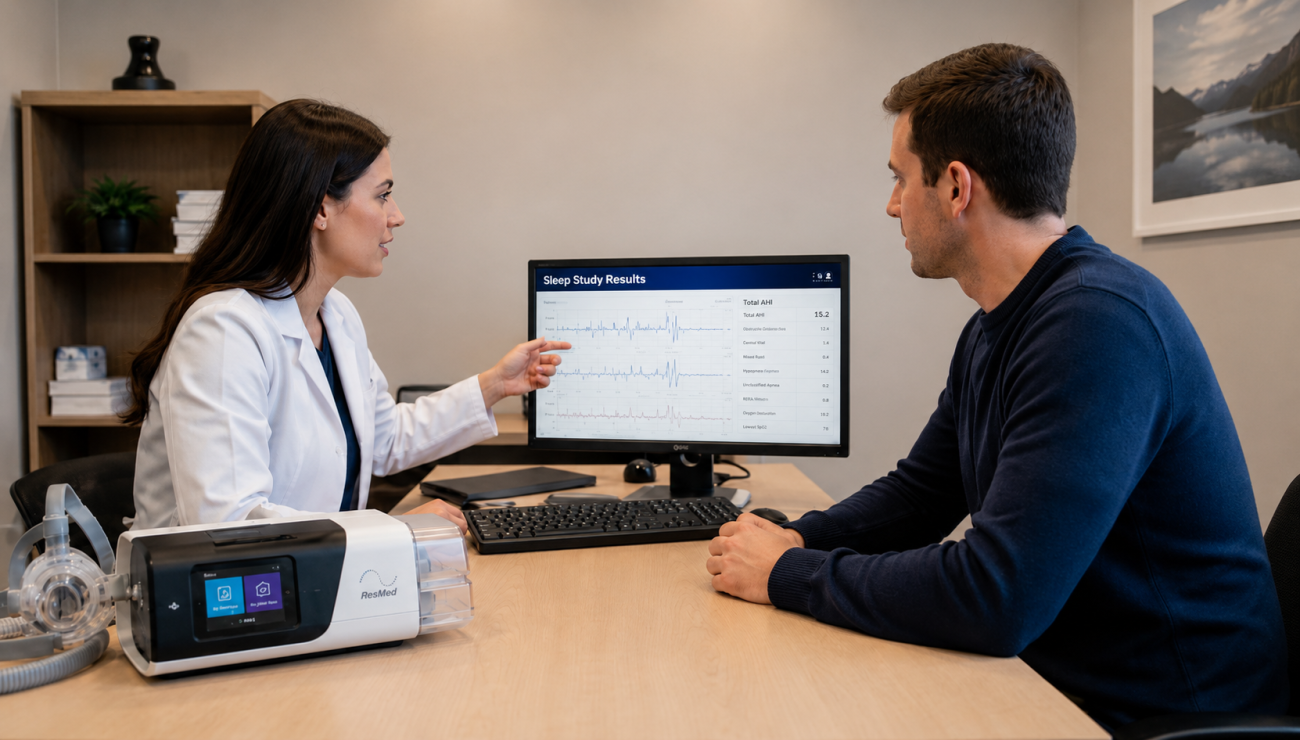
Your home sleep test results center on a measurement called the apnea hypopnea index (AHI). This is the average number of breathing disruptions per hour of sleep. An AHI under 5 counts as normal. An AHI between 5 and 14 indicates mild sleep apnea. Between 15 and 29, the condition is moderate. At 30 or above, it is severe.
Your Sleep Clinician reviews these numbers with you. They explain what the numbers mean in the context of your symptoms and overall health. The review also notes how much your blood oxygen dropped during the recorded events. In addition, it covers how your breathing patterns behaved across different positions and sleep stages.
If sleep apnea is confirmed, your Sleep Clinician will discuss CPAP therapy. They will also recommend the right device type and pressure settings based on your results. You can read more about treatment options for sleep apnea in Ontario before your results appointment. That way, you are prepared for the conversation.
What Happens After Your Home Sleep Test?
If your home sleep test confirms obstructive sleep apnea, treatment begins promptly. Your Sleep Clinician recommends the appropriate device. They also calibrate the pressure settings to match your AHI and oxygen data. In addition, they fit you for a mask in person. As a result, most patients leave their results appointment with their CPAP equipment or with a clear plan for obtaining it.
If your home sleep test results are inconclusive, your Sleep Clinician will recommend an in lab study to gather additional data. The same applies if the results reveal a pattern that suggests something more complex than obstructive sleep apnea. This is not uncommon, and it is not a setback. Instead, it simply means you need more detailed information to get the right diagnosis and treatment.
The Ontario Sleep Care care model includes ongoing follow up. Your Sleep Clinician checks in as you adjust to therapy, reviews your compliance data, and makes adjustments as needed. Most importantly, the goal is not just a diagnosis. It is a treatment that actually works for your life. Learn more about ongoing patient support at Ontario Sleep Care.
Frequently Asked Questions
Is a home sleep test as accurate as an in lab study?
For appropriate candidates, a home sleep test is clinically reliable. These candidates are adults with suspected uncomplicated obstructive sleep apnea. In contrast, patients with complex sleep disorders, additional medical conditions, or unclear clinical pictures need more comprehensive data. An in lab study provides that data. Your Sleep Clinician determines which format is right for your situation.
Does OHIP cover home sleep tests in Ontario?
Coverage depends on where and how the test is conducted. Therefore, speak with your physician and Ontario Sleep Care about which tests qualify for coverage in your specific situation. Ask them what out of pocket costs, if any, may apply.
How long does it take to get the results of a home sleep test?
Results are typically available within a few business days after you return the device. Then, your Sleep Clinician schedules a follow up appointment to review findings and discuss next steps.
Can I use my CPAP during a home sleep test?
No. If you already use a CPAP machine, your Sleep Clinician will advise against using it on the night of the diagnostic test. The test captures your untreated breathing patterns. Therefore, using therapy would alter the results.
What if I cannot sleep properly during the home sleep test?
A night of slightly disrupted sleep is still useful for diagnostic purposes. Most devices can detect meaningful breathing events even with reduced sleep time. However, if the data quality is too poor to interpret, your Sleep Clinician may arrange a repeat test or recommend an in lab study instead.
If you are ready to take the first step toward a diagnosis, a home sleep test in Ontario can provide answers quickly and comfortably. Contact Ontario Sleep Care to speak with a Sleep Clinician. Together, you can find out whether a home sleep test is right for your situation.